Prada Bag Split Packing & Shipping Fees on FashionReps
Introduction When viewing a Prada bag or similar style on [FashionReps](https://fashion-reps.net/), the easiest thing to misjudge before combining packages is not the listed price, but packaging volume, chargeable weight, service fees, payment fees, and route restrictions. Whether a bag is suitable for combining with other items cannot be determined solely by the number of items, nor can shipping costs from other orders be directly applied. This article is for buyers who have already found a spe
Marcus Feld is the site's Editor in Chief and writes most of its replica-sneaker reviews. His coverage includes shoe construction, leather grain comparisons, midsole tooling, the Kakobuy agent-ordering process, and observable details in QC photos. He runs the fit lab, measuring insole length, heel stack and shoe weight, inspecting stitch density at 10x magnification, and comparing leather grain with retail references. He also logs agent response times from ordering to warehouse QC. The reviews focus on these measurements and observable differences between the shoes and their retail references.
Editor score 4.2 / 5
In this article
Introduction
When viewing a Prada bag or similar style on FashionReps, the easiest thing to misjudge before combining packages is not the listed price, but packaging volume, chargeable weight, service fees, payment fees, and route restrictions. Whether a bag is suitable for combining with other items cannot be determined solely by the number of items, nor can shipping costs from other orders be directly applied.
This article is for buyers who have already found a specific Prada bag product page, plan to use an external shopping agent, and want to compare standalone shipping and combined shipping conditions before submitting an international parcel. After reading, you should be able to complete evidence organization: confirm product and packaging information, unify calculation conditions, distinguish various fees, and based on verification results decide to combine, split, or hold submission.
The article does not provide unverified prices, stock, sizes, materials, shipping costs, taxes, or fixed route commitments. Information displayed on product pages, shopping agent pages, and official shipping calculators may change over time, by destination, packaging method, and actual warehouse measurements. Record the query date, destination, currency, and applicable restrictions before submission. 🧾
What Problem This Solves for Prada Bag Before Combining
The core issue is: after seeing a Prada bag on a FashionReps product page, how to determine whether it should be shipped alone or combined with other items to avoid unpredictable costs and risks due to changes in packaging volume, chargeable weight, or route conditions.
Here, "split packing" does not mean buyers should disassemble the product themselves, nor does it guide evasion of inspection, under-declaration, or splitting orders to avoid taxes. It refers to confirming the following choices with the shopping agent before submitting the parcel:
- Keep the bag's original packaging or remove unnecessary external packaging;
- Whether the bag is combined with other items into the same parcel;
- Whether to split into multiple parcels to meet route, size, or declaration requirements;
- Whether the parcel can be re-weighed and measured before submission;
- Who is responsible for confirming destination country taxes, import restrictions, and declaration documents.
Combining may reduce duplicate fixed operating costs, but may also increase the parcel's volumetric weight, declared value, and single-loss risk. Splitting may increase multiple handling or shipping costs, but is easier to control when route restrictions, size limits, or high-value item risks are higher. There is no uniform "cheapest solution" applicable to all orders.
Record Style, Size, and Current Visible Information from FashionReps Product Page
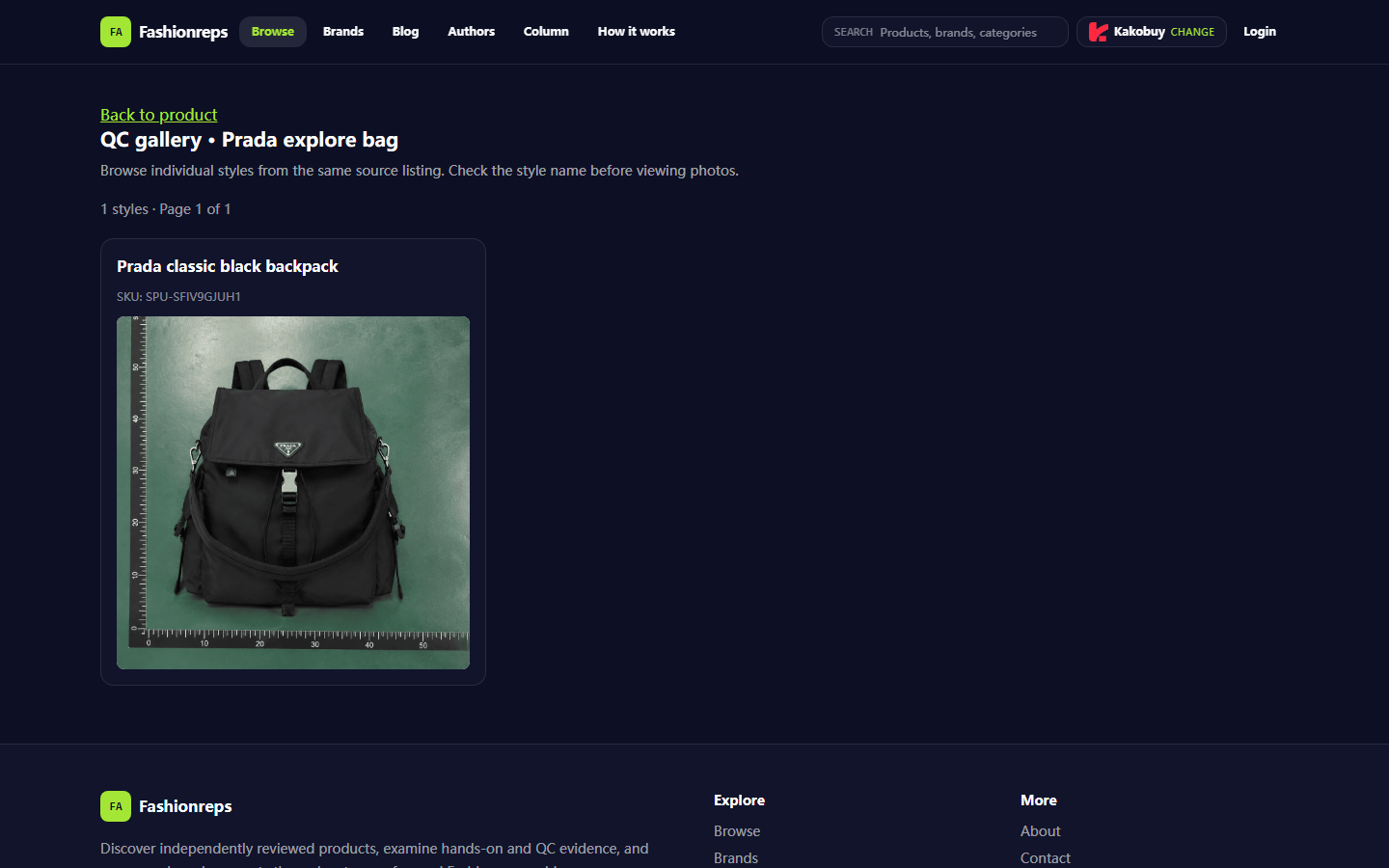
The currently verifiable FashionReps page is the QC page for the Prada explore bag. The page shows one independent style under this source, with the style name listed as Prada classic black backpack, SKU SPU-SFIV9GJUH1. This page is mainly for viewing the product style and QC images, and does not mean the shopping agent has confirmed stock, final packaging dimensions, international shipping costs, or ready-to-ship status.
The specified QC page screenshot is below, serving only as auxiliary record of style and page information, not as proof of actual material, weight, authenticity, durability, or final packaging quality.

When creating a record from the product or QC page, at least save the following fields:
- Product name and style name displayed on the page;
- SKU, product identification information, or source page identifier;
- Color, size options, and quantity displayed on the page;
- Price and currency visible on the product page, and query date;
- Whether the page shows stock, pre-sale, out-of-stock, or other status;
- Whether QC images are available and sufficient to judge appearance and packaging;
- Whether the page clearly states product dimensions, weight, material, or packaging contents;
- Whether the page information comes from the product page, QC page, agent warehouse page, or other pages.
If the page does not show the bag's own weight, packaged weight, length, width, height, whether it includes shoe-box-type hard packaging or other external protective layers, do not estimate and write as definite facts. Mark these fields as "pending warehouse measurement."
Visible information on product pages alone cannot prove the following:
- The actual received product is exactly the same as page images;
- The product has passed the shopping agent's inbound inspection;
- The parcel is suitable for a specific international route;
- A destination country will definitely not incur taxes or customs clearance requirements;
- The product can be safely combined with other items.
How to Verify Bag Quantity, Packaging Protection, and Parcel Dimensions
Combining decisions should start from the warehouse or shopping agent's actual parcel records, not from the product title. For bags, focus on external volume, whether handles and decorative parts are prone to pressure, whether there is a dust bag or padding, and whether removing packaging changes protection level.
Confirm with the shopping agent in the following order:
- Whether the product has been received and completed viewable QC checks.
- Whether the single item quantity in current warehouse records matches the order.
- What is the actual weighing result of a single item, including external packaging.
- What are the current packaging length, width, and height, and measurement units.
- Whether there is hard box, padding, or protective packaging beyond the bag's own dimensions.
- After removing or changing packaging, will the shopping agent re-weigh and measure.
- After combining other items, will the final parcel weight and dimensions be recalculated.
- Whether extra protection is needed for the bag's appearance, handles, hardware, and shape.
- Is current packaging sufficient against pressure, friction, or squeezing during transit.
- Does the parcel have route restrictions on weight, longest side, volume, or declaration.
Do not directly treat smaller-looking packaging in QC images as international shipping packaging. Photos may only show the product or partial packaging and cannot replace actual warehouse measurements.
If the shopping agent only provides single item weight without packaged three-dimensional dimensions, mark "volumetric weight" and "final route price" as pending verification. If only total parcel weight is shown without itemized records, it is impossible to accurately determine which item mainly increases shipping costs.
What Calculation Conditions to Unify for Single vs Combined Parcel
When comparing standalone and combined shipping, the same destination, currency, query time, and fee basis must be used. Comparing only total prices displayed on two pages can easily mix product price, warehouse service fees, and international shipping costs.
At least unify the following conditions:
- Destination country and receiving region, to state, province, or postal code if necessary;
- Shipping route or service type;
- Number of items in parcel;
- Actual product weight and packaged weight;
- Length, width, height, and the shopping agent's volumetric weight rules;
- Declaration information and applicable product category;
- Payment currency and exchange rate query time;
- Whether warehouse handling, reinforcement, repackaging, or insurance options are included;
- Whether fees are estimates and may be adjusted after warehouse review;
- Whether destination taxes, customs fees, or other recipient-borne costs are additional.
Use the following record framework to maintain consistency:
| Comparison Item | Standalone | Combined Parcel | Verification Requirement |
|---|---|---|---|
| Number of items | Record actual quantity | Record actual quantity after combining | Match order and warehouse records |
| Product and packaging weight | Use warehouse measured value | Use re-measured value after combining | Mark unit and measurement time |
| Parcel dimensions | Use single item packaging dimensions | Use combined three-dimensional dimensions | Confirm impact on volumetric weight |
| Route and destination | Keep fixed | Keep fixed | Do not directly compare different routes |
| Product and service fees | Record separately | Record separately | Do not merge into international shipping |
| International shipping cost | Based on official calculator or agent quote | Re-query with combined data | Record query time and restrictions |
| Taxes and customs | Confirm separately | Confirm separately | Do not interpret "not shown" as "none" |
If the official calculator or agent quote page does not show specific values, record only "not yet quoted" or "needs review after submission," and do not fill in estimated amounts. 📦
How to Separately Record Service Fees, Payment Fees, Packaging Fees, and International Shipping
An order may contain multiple fee layers. To avoid misjudging whether combining is worthwhile, split fees into the following categories:
Product Price
This is the product amount displayed on the product page or shopping agent order. Record currency, price display time, quantity, style, and options that may affect price. Product price does not equal final landed cost, nor does it equal international shipping cost.
Service Fee
Service fees may relate to purchasing, warehouse handling, order processing, quality inspection, or other agent services. Whether they are charged and how calculated should be based on the shopping agent's current page and order details. Do not infer that the current order will not charge fees because other platforms once provided free services.
Payment Fee
Payment fees may vary with payment method, currency, account region, or agent policy. If the page does not separately list payment fees, record as "not separately shown," and do not add a fixed percentage estimate.
Packaging Fee
Packaging fees may include repackaging, reinforcement, removing outer packaging, adding protective materials, or special handling. Packaging adjustments may change weight and dimensions, so packaging fees cannot be judged apart from final parcel data.
International Shipping Fee
International shipping fees need confirmation with destination, route, chargeable weight, parcel dimensions, query time, and service conditions. Even if two parcels have similar actual weights, differences in volume, longest side, or route restrictions may lead to different results.
Taxes, Customs, and Destination Fees
Taxes, import restrictions, and customs documents are part of destination country rules and specific shipping conditions. Do not interpret the absence of fees on the shopping agent page as tax exemption, and do not reduce costs through under-declaration, order splitting to evade taxes, or inspection avoidance. Compliant declaration and document preparation should be based on destination country official requirements and carrier instructions.
When recording, fill in separately: product price, service fee, payment fee, packaging fee, international shipping fee, insurance or additional services, destination taxes, customs fees, and other pending fees. Only when the status of all items is clear is final comparison appropriate.
Destination, Route, Chargeable Weight, and Query Time in Official Calculator
When using the official shipping calculator of the shopping agent or carrier, first confirm whether the page shows estimated shipping, warehouse quote, or final cost after actual submission. Calculator results usually depend on input conditions and cannot be cited independently.
Save at least the following for each query:
- Query date and time;
- Destination country, region, and postal code;
- Route name or service type;
- Number of parcels;
- Actual weight, volumetric weight, or chargeable weight;
- Length, width, height, and units;
- Declaration currency and amount;
- Whether reinforcement, insurance, packaging removal, or other services are selected;
- Restrictions, notes, and valid conditions displayed by the calculator;
- Whether results note fuel surcharges, remote area fees, or other possible adjustments.
If the calculator only asks for weight and not dimensions, do not assume it completely ignores volume. Read the calculator's billing instructions and confirm whether the route uses actual weight, volumetric weight, or the greater of the two.
If the same product shows different results at different query times, keep both records and note the input conditions causing the difference. Do not automatically write the latest query as a long-term fixed price.
For products like Prada bags that may need shape and appearance protection, re-record weight and dimensions before and after packaging adjustments. If removing hard packaging can reduce volume but increases risk of crushing or deformation, the saved shipping amount must be evaluated together with the new risk, not just looking at the lower quote.
How to Build a Pending Verification List When Product Page or Logistics Data Is Missing
Missing data does not mean the order cannot proceed, but it means a definite combining conclusion cannot be made now. Suggest dividing missing items into four groups: product data, warehouse data, shipping data, and compliance data.
Product data pending verification:
- Whether product name and style match target product;
- Whether SKU or order identification information is complete;
- Page price, currency, and query time;
- Quantity, color, size, and stock status;
- Whether QC images or quality inspection records exist;
- Whether page describes material, product dimensions, and packaging contents.
Warehouse data pending verification:
- Inbound quantity;
- Single item actual weight;
- Single item packaged length, width, height;
- Weight and three-dimensional dimensions after combining;
- Current padding, hard box, dust bag, and outer box;
- Cost of removing packaging, reinforcement, or repackaging;
- Whether re-measurement will occur after packaging adjustment.
Shipping data pending verification:
- Destination and postal code;
- Available routes;
- Actual weight and volumetric weight rules;
- Restrictions on longest side, weight, and number of parcels;
- Conditions for difference between estimated shipping and final settlement;
- Insurance, surcharges, and remote area fees;
- Expected tracking information and exception handling.
Compliance data pending verification:
- Destination country import restrictions for relevant product category;
- Declaration documents required by carrier;
- Possible taxes and customs fees;
- Order, payment, and logistics records the recipient needs to keep;
- Whether there is additional risk in using brand and images.
When key data is missing, the most prudent state is "hold submission and complete evidence" rather than substituting numbers from other products, countries, or routes. 🔍
Final Action: Decide Combine, Split, or Hold Based on Evidence
Handle this Prada bag in the following decision order:
Combine First
Applicable when item quantity, warehouse measured weight, combined three-dimensional dimensions, destination, and route are confirmed, and packaging protection still meets shipping needs. Before submission, confirm combining will not trigger size, weight, declaration, or route restrictions, and save measurement records before and after combining.
Split
Applicable when combining leads to route restrictions, significant increase in volumetric weight, need for independent protection of the bag, or too high parcel value and single-loss risk. Splitting may increase fixed costs and multiple shipping costs, but helps reduce concentrated risk in a single parcel. Whether splitting is worthwhile must be re-queried with actual samples, not judged by experience.
Hold Submission
Applicable when key gaps remain in product page, QC data, stock status, packaging dimensions, destination, route, or fee details. Holding is not failure, but avoiding irreversible submission, payment, or shipping when conditions are incomplete.
The final record should at least answer four questions:
- What confirmed costs does the combining plan save, in what currency and query time;
- What risks does combining add, including volumetric weight, crushing, declaration, customs, and single-loss risk;
- What type of buyer is this plan suitable for, such as those with complete product data, clear destination, and acceptance of combining risk;
- Under what conditions is it not recommended, such as missing packaging data, unconfirmed route restrictions, need for special product protection, or unclear destination country information.
If product records, warehouse measurements, route conditions, and destination requirements cannot be confirmed simultaneously, do not treat "looks cheaper" as the final conclusion. For current data, whether the Prada bag should be combined must be determined by cross-verification of FashionReps product records, shopping agent warehouse measured data, and official shipping conditions.
Agent Platform Shopping FAQ
1. What categories of products can be found on litbuy-ai.com?
On litbuy-ai.com, you can browse an extremely wide range of products, including: shoes, T-shirts, sweaters, hoodies, jeans, sweatpants, shorts, beach shorts, factory clearance items, down jackets, baseball shirts, shirts, hats, jewelry, bags, electronics, sunglasses, socks, underwear, and trendy collectibles.
2. How to judge product quality on litbuy-ai.com?
When evaluating product quality, refer to QC photos and do not rely solely on factory-provided images, as those are often retouched. Use QC photos to verify whether product details meet your specific standards before deciding to place an order.
Also note, avoid purchasing products that are too cheap, as they are often of poor quality.
3. What types of products are included in the litbuy-ai.com spreadsheet?
The products listed in the litbuy-ai.com spreadsheet include shoes, clothing, bags, accessories, jerseys, perfumes, hats, scarves, belts, and various home and lifestyle products.