New Balance Winter Shoes: Grip and Commute Fit
## The Commute Choice This New Balance Shoe Evaluation Aims to Solve If you're planning to wear [New Balance shoes](https://fashion-reps.net/shoes/new-balance) for fall/winter commuting, the first thing to confirm isn't whether they "look like running shoes," but whether the product page provides enough evidence to judge the relationship between the outsole tread pattern, coverage, and your target surfaces. The item under review comes from the fashion-reps New Balance ML2002 leather QC page. Rev
Marcus Feld is the site's Editor in Chief and writes most of its replica-sneaker reviews. His coverage includes shoe construction, leather grain comparisons, midsole tooling, the Kakobuy agent-ordering process, and observable details in QC photos. He runs the fit lab, measuring insole length, heel stack and shoe weight, inspecting stitch density at 10x magnification, and comparing leather grain with retail references. He also logs agent response times from ordering to warehouse QC. The reviews focus on these measurements and observable differences between the shoes and their retail references.
Editor score 4.2 / 5
In this article
The Commute Choice This New Balance Shoe Evaluation Aims to Solve
If you're planning to wear New Balance shoes for fall/winter commuting, the first thing to confirm isn't whether they "look like running shoes," but whether the product page provides enough evidence to judge the relationship between the outsole tread pattern, coverage, and your target surfaces.
The item under review comes from the fashion-reps New Balance ML2002 leather QC page. Review date: October 17, 2026. The page confirms the style classification and QC image entry, but the current materials are not sufficient to prove the outsole's actual grip performance on wet surfaces. Therefore, this article's conclusions only cover visible page information, image evidence boundaries, and pre-purchase verification methods, and do not present image observations as real-world wear tests. 🔍
After reading, you should be able to do three things: first, judge whether the page shows sufficiently clear outsole information; second, request additional images based on your own commute surfaces; third, decide whether to keep, hold, or skip the item. This article does not apply to scenarios requiring professional slip-resistance certification, snow-boot-level protection, or explicit safety ratings for work environments.
Locking Down Style, Color, Size, and Outsole Information on the Target Product Page
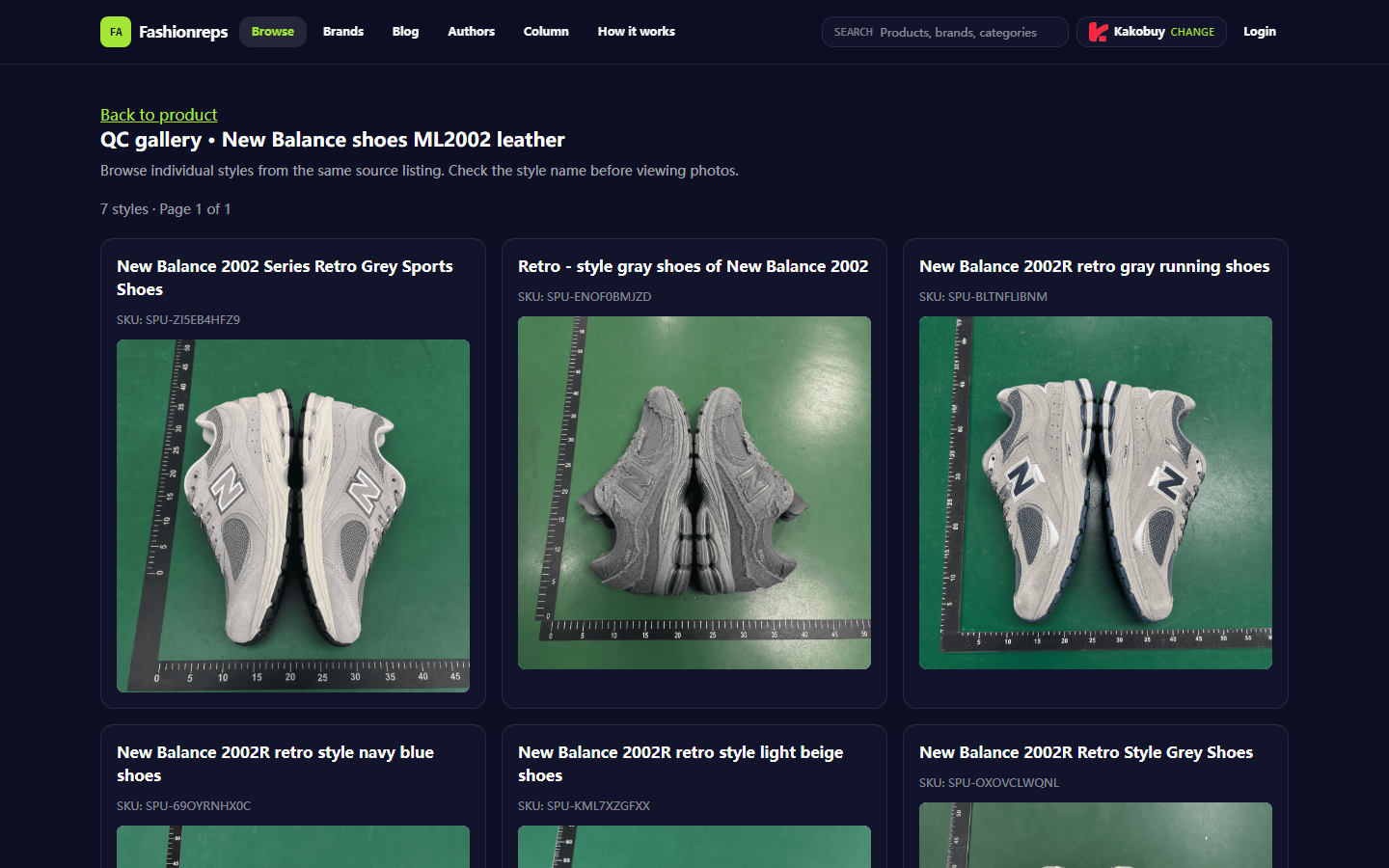
The page title reads "New Balance shoes ML2002 leather" and provides a QC gallery. The page also lists 7 styles from the same source, including gray, vintage gray, navy, light beige, and various 2002 series names.
These names can help buyers first confirm which style they are viewing, but they cannot directly prove that every color or style uses the exact same outsole. Before purchasing, map the following information to the specific SKU rather than relying only on the series name:
- Product name and specific style name
- Color, and the color corresponding to the page images
- Available sizes and size chart
- Clear images of the outsole side, bottom, and heel
- Whether the page provides material, outsole construction, or production information
- Whether current stock, price, and purchase process are still valid
This review did not have complete page data to confirm stock, price, size range, or outsole material, so these items cannot be treated as verified facts. If page information changes, re-check before ordering. 📅

Image: Screenshot used to confirm product classification, style name, and QC image entry. Image source: fashion-reps product page, used solely for this article's product review illustration.
Identifying Visible Outsole Tread and Coverage from Product Images
The first step in image review is not to judge whether "grip is good," but to record what the images actually show. It's advisable to check in the following order:
- Is there a full outsole bottom view, rather than only side or upper views?
- Are the forefoot, midfoot, and heel all in the frame?
- Is the tread continuous, and are the groove directions clearly discernible?
- Are there obvious signs of wear, flattening, dirt, or obstruction on the outsole edges?
- Are both left and right outsoles shown, and could there be angle differences?
- Is the image resolution sufficient to distinguish tread depth and coverage area?
If you can only see the upper, outsole sidewall, or a partial outsole, the most you can record is "the page's display scope is limited." You cannot infer wet-surface grip, wear time, or rainy-day stability from that. Even if the tread looks deep, it cannot replace material friction testing or actual road testing. ⚠️
Building a Surface Checklist for Dry, Pavement, and Indoor Ground
Commute routes rarely consist of only one type of surface. You can start by breaking your route into dry pavement, indoor hard floors, subway station or mall smooth floors, and wet roads after rain, then check page evidence item by item.
| Commute Surface | What to Confirm from Images or Materials Before Purchase | Can Current Materials Confirm Directly? | What Cannot Be Inferred |
|---|---|---|---|
| Dry pavement | Complete outsole view, forefoot and heel tread | Requires specific bottom view | Cannot confirm long-term wear resistance |
| Indoor smooth hard floors | Clear image of outsole contact surface, any dirt or wear | Cannot confirm from upper images alone | Cannot guarantee no slipping |
| Wet pavement after rain | Outsole tread, material description, applicable scenario | Current materials insufficient | Cannot prove wet-surface grip performance |
| Stairs and ramps | Complete coverage view of heel and forefoot | Need additional QC images | Cannot confirm stability on slopes |
The purpose of this table is to help you ask specific questions, not to give the shoe a score without test evidence. If your route mostly passes through wet surfaces, ramps, or smooth stone, the evidence requirements should be higher than for ordinary dry streets. 🌧️
Distinguishing Page Specs, Image Evidence, and Editorial Judgment
The most easily confused types of information in purchase decisions are threefold:
- Page specs: product name, style name, size chart, material description, etc.
- Image evidence: outsole angle, tread coverage, upper stitching, visible wear, etc.
- Editorial judgment: fit recommendations based on evidence, such as "suitable for further verification" or "hold off purchase."
These three cannot replace one another. The page stating a series name does not mean the page has proven the outsole is suitable for rain. Images showing tread do not mean friction testing has been completed. Editorial judgment only indicates whether evidence is sufficient to support the next step.
What can be confirmed now is that the page provides a QC entry for ML2002 leather and lists multiple related styles. Current materials do not provide complete outsole details, material testing, or test records under different weather conditions. Therefore, the more prudent judgment is: first supplement evidence, then decide whether to use it as an everyday fall/winter commute shoe.
Evidence Boundaries for Upper, Protection, and Weather Suitability in Fall/Winter Wear
Fall/winter suitability is not only about the outsole. Also check separately whether the upper has visible openings, whether the tongue and lacing area are prone to water ingress, whether the collar height meets your needs, and whether the page has explicit waterproof or protective descriptions.
If the page does not explicitly state waterproof, insulation, or slip-resistance ratings, do not treat leather appearance, thick outsole, or fall/winter colorways as functional proof. Upper images can help identify appearance and structure, but cannot prove waterproofing duration, insulation ability, or performance in rain and snow.
For ordinary urban commuting, you can divide your goals into three tiers:
- Only need dry-weather wear: focus on supplementing complete outsole views and size information.
- Frequently encounter wet roads after rain: also need to confirm outsole details, material description, and actual photos the seller can provide.
- Frequently pass through standing water, ice, snow, or steep slopes: if there is no explicit functional information, it is advisable to choose a professional shoe with more complete evidence.
This is not a denial of the product's performance, but a limitation of the evidence scope. When there is no test data, a conservative judgment is more reliable than treating appearance as function. ✅
Situations Where Insufficient Information Prevents Inferring Grip or Durability
If any of the following occurs, do not write "good grip," "wear-resistant," or "suitable for rain" as a definite conclusion:
- Only upper images, no complete outsole bottom view.
- Outsole images are too dark, too small, or cropped, making tread unrecognizable.
- Only one shoe or one angle, unable to confirm forefoot and heel.
- No outsole material, tread depth, or applicable scenario description.
- No test records for dry, wet, or smooth surfaces.
- Product name cannot be matched to the specific style in QC images.
- Page price, stock, or size information not re-verified before ordering.
In these cases, it is recommended to phrase the conclusion as "insufficient evidence, awaiting additional images," rather than using star ratings or absolute adjectives to replace facts. This also avoids mistakenly applying observations from one color or style to the entire series.
Pre-Purchase Checklist: Verify, Hold, or Skip
Before ordering, handle in this order:
- Save the target style name and corresponding SKU to avoid confusion among multiple 2002 series images.
- Request clear images of the outsole front, side, heel, and both shoes.
- Confirm the shoes in the images match the target color, size, and specific style.
- Re-check price, stock, size chart, seller information, and purchase process.
- Compare your commute surfaces with the checklist item by item.
- If key outsole evidence is still missing, hold the order and do not treat uncertainty as a performance promise.
The final judgment can be simple: if your route is primarily dry, flat surfaces, and the page has supplemented outsole and size evidence, you can continue evaluating; if the route is often wet, slippery, or sloped, and the page lacks corresponding tests or clear bottom images, it is not advisable to purchase based on appearance alone; if you need professional slip-resistance, waterproofing, or snow protection, choose a shoe that can provide explicit specifications and applicable scope.
This review did not calculate combined or split shipping savings, because current materials lack shipping cost, package weight, dimensions, or destination country information. The most realistic "saving" for this shoe is avoiding return or repurchase costs due to insufficient evidence; the increased risk is that waiting for verification prolongs decision time, and holding the order may miss stock changes. Suitable for buyers willing to check QC materials first and whose commute surfaces are relatively clear; not suitable for those who need immediate confirmation of professional slip-resistance, or who are unwilling to bear the risk of insufficient page evidence.
Article Image