How to Verify Storage Fees for Polo Ralph Lauren Knitwear
Introduction When checking storage and shipping fees for fall/winter knitwear, you can't just look at the product price or a single total on the settlement page. What you really need to confirm is: whether the item matches the target style, when it arrived at the warehouse, when storage fees start, how much volume it takes up after packaging, which international shipping route is used, and whether the destination and currency are correct. 📦 The clear task for this verification is to establish a
Marcus Feld is the site's Editor in Chief and writes most of its replica-sneaker reviews. His coverage includes shoe construction, leather grain comparisons, midsole tooling, the Kakobuy agent-ordering process, and observable details in QC photos. He runs the fit lab, measuring insole length, heel stack and shoe weight, inspecting stitch density at 10x magnification, and comparing leather grain with retail references. He also logs agent response times from ordering to warehouse QC. The reviews focus on these measurements and observable differences between the shoes and their retail references.
Editor score 4.2 / 5
In this article
Introduction
When checking storage and shipping fees for fall/winter knitwear, you can't just look at the product price or a single total on the settlement page. What you really need to confirm is: whether the item matches the target style, when it arrived at the warehouse, when storage fees start, how much volume it takes up after packaging, which international shipping route is used, and whether the destination and currency are correct. 📦
The clear task for this verification is to establish a fee record for a Polo Ralph Lauren fall/winter knitwear item from inbound to before payment. After completion, the buyer should be able to determine which fees have evidence, which fees still need confirmation from the warehouse or official calculator, and to pause payment when key conditions are missing. This article does not apply to packages that have already been paid for and require after-sales dispute handling, nor does it apply to using historical screenshots to estimate current rates.
What Does This polo ralph lauren Knitwear Fee Verification Aim to Solve
The core of fee verification is not to find a seemingly cheap number, but to break down the costs incurred by the same package at different stages. At the very least, you need to separately record the product price, platform or agent service fees, payment-related fees, packaging fees, storage fees, international shipping fees, possible taxes, and exchange rate differences.
This verification also needs to answer four questions:
- Is the target item indeed a fall/winter knitwear item, and not another category from the same brand.
- Has the warehouse recorded the item quantity, size, and inbound status.
- Is there readable evidence for the storage fee start date, free period, and billing cycle.
- Have the packaged weight, volumetric weight, destination, and shipping route entered the official shipping fee calculation process.
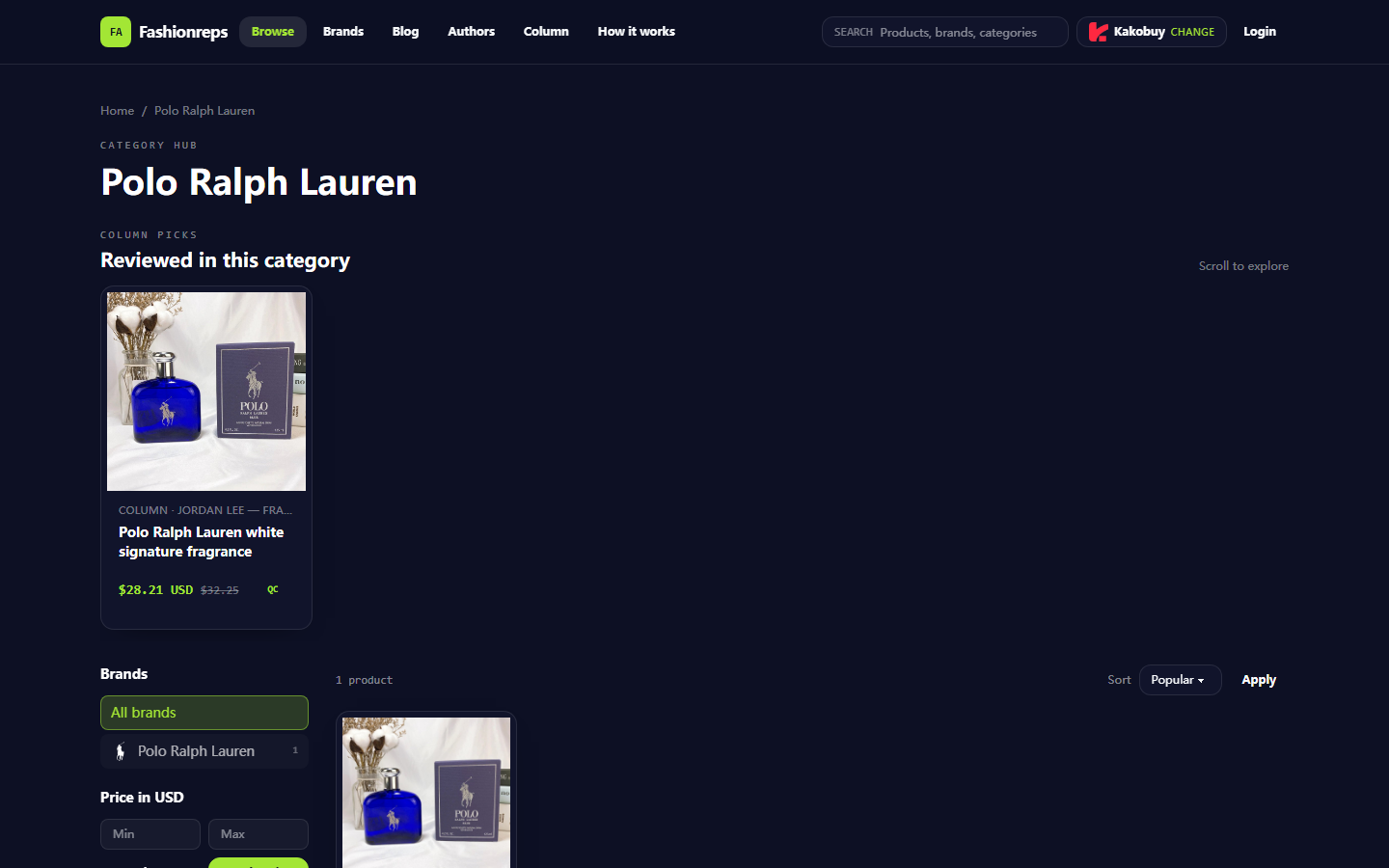
Currently visible on-site records point to a Polo Ralph Lauren fragrance category page, and the page summary shows fragrance products, not knitwear. That page cannot prove the target knitwear's price, inventory, size, weight, or storage conditions. Therefore, this article does not use that page as evidence for the knitwear item, nor does it output unverified product amounts or shipping fees. 🔎
First Verify Target Site's Visible Product, Size, Quantity, and Current Link
Before building the fee table, confirm the item's identity first. The product name should at least include clear category information, such as knitwear, sweater, or corresponding clothing description; if the page only shows the brand name, images, or other category names, you cannot directly infer it as the target item.
It is recommended to save the following evidence:
- The currently accessible URL of the product page, with the system handling the link after saving the article.
- The product title and category displayed on the page.
- Available sizes, colors, and purchase quantity.
- The displayed product price, currency, and query time.
- Whether the page shows out of stock, delisted, redirected, blank content, or only a list of tags.
- If the item comes from an external seller, also record the seller name and product page status.
If the page cannot clearly prove that the target is a fall/winter knitwear item, mark the product status as pending confirmation instead of using the brand name or image appearance to fill in missing information. In particular, you must not infer clothing material, dimensions, inventory, and packaging weight based on fragrance, accessory, or other product records on the page.
How to Separate Inbound, Storage, Packaging, and International Shipping Fee Fields
It is recommended to use one record per package or consolidated batch, and avoid mixing product fees and logistics fees. Fields can be grouped as follows:
| Fee Stage | Fields to Record | Handling When Missing |
|---|---|---|
| Product | Product name, size, quantity, product price, currency, query time | Stop calculation when category or price cannot be confirmed |
| Inbound | Inbound time, warehouse status, package number, inspection status | Without an inbound record, storage duration cannot be calculated |
| Storage | Start date, free period, billing cycle, rate conditions, accumulated days | Without official terms, only record as pending verification, do not fill in amounts |
| Packaging | Packaging method, actual weight, length/width/height, volumetric weight, packaging fee | Without reweighing or dimension records, billing weight cannot be determined |
| Shipping | Destination, route, currency, shipping fee calculation time, restrictions | Do not accept estimated results when destination or route is missing |
Payment fees and exchange rates must also be recorded separately. Payment fees may vary by payment method, order amount, or service provider terms; exchange rates should note the rate source, conversion time, and whether platform conversion differences are included. Without these conditions, you can only keep the original currency and cannot treat an unexplained conversion result as the final cost. 💳
What Evidence Should Be Recorded for Storage Start Time and Package Status
The most error-prone part of storage fee verification is mistaking the order time for the inbound time, or mistaking the warehouse sign-off time for the end of the free period. Actual records should at least distinguish:
- Order time: when the product order was submitted.
- Seller shipping time: when the seller handed the item to the carrier.
- Warehouse sign-off time: when the warehouse system confirmed receipt of the package.
- Inbound completion time: when photography, inspection, or shelving processing was completed.
- Package creation time: when consolidation or shipping request was submitted.
- Outbound time: when the package was handed to the international carrier.
If the service provider's rules clearly state that the start date is from sign-off date, inbound completion date, or another point, that rule should be followed and the page or order record should be saved. If different pages show different start dates, record the discrepancy first and do not choose a more favorable date to calculate directly. 🗓️
Also confirm whether the package is in a status such as pending inspection, pending additional payment, pending consolidation, pending payment, pending outbound, or shipped. Different statuses may correspond to different storage or handling conditions. Without official explanation, you cannot assert that a certain status is free or that storage fees have stopped.
How to Confirm Knitwear Packaging Volume, Compression Conditions, and Billing Weight
Knitwear can be affected by folding method, outer packaging, whether original packaging is kept, and whether compression is applied, but these factors cannot be directly converted into specific weight or volume based on experience. During verification, the warehouse should be asked to provide actual measurement information, including:
- Actual package weight and measurement time.
- Length, width, and height after outer packaging is completed.
- Applicable volumetric weight formula and divisor.
- Which of actual weight and volumetric weight is used for billing.
- Whether shoe boxes, gift boxes, hangers, or other extra packaging is included.
- Whether compression, repackaging, or removal of original packaging incurs handling fees and risks.
If compression packaging is chosen, it may reduce volume but may also increase wrinkles, packaging damage, or difficulty maintaining original condition for returns or exchanges. If original packaging is kept, package volume and billing weight may increase. The final decision should be based on warehouse reweighing and official calculation rules, not using the net weight from the product details page as the shipping weight.
Destination, Route, and Timestamp in the Official Shipping Calculator
Shipping fee calculation results must simultaneously record destination, route, weight or volume, currency, and query time. The destination should at least specify the country or region, and if necessary, state, province, postal code, or remote area conditions should be confirmed. The route name should not just say "international shipping"; the specific service name shown by the calculator should be preserved.
For each query, it is recommended to save:
- Query date and time, using local time and noting the time zone.
- Destination country and necessary regional information.
- Billing weight and dimension source.
- Selected shipping route and service level.
- Shipping fee display currency.
- Whether fuel surcharges, remote area surcharges, insurance, customs duties, or other fees are included.
- Quote validity period and restrictions.
If the official calculator requires login, warehouse measurement data, or the current page cannot be accessed stably, only record "pending query". Do not use search result summaries, old order screenshots, or shipping fees for other packages as substitutes for the current target package quote. ⏱️
How to Output Verification Process Without Fabricating Amounts When Real-Time Rates Are Unavailable
The currently visible evidence does not provide a valid product page for the target knitwear, warehouse inbound records, packaging measurement data, or real-time shipping quotes for a specific destination. Therefore, this article only outputs the verification process, without outputting product price, storage fees, packaging fees, international shipping fees, or exchange rate conversion amounts.
You can first establish the following to-do sequence:
- Add and confirm a valid product page for the target knitwear.
- Record size, quantity, product price, currency, and query time.
- Save warehouse sign-off or inbound time, and the current package status.
- Obtain the storage rule's start date, free period, and billing cycle.
- After inspection or packaging, obtain actual weight and outer packaging dimensions.
- Enter destination and route in the official shipping calculator, save a timestamped quote.
- Separately record payment fees, exchange rates, and any taxes not included.
- After all key fields are complete, compare total costs for consolidation, splitting, or different routes.
Such a result does not provide an immediate total price, but it avoids adding incomparable data and preserves the evidence chain needed for future follow-up with the warehouse or service provider.
Stop Conditions When Fee Conditions Are Incomplete
If any of the following situations occur, payment or shipping submission should be paused:
- The product page cannot prove that the target is knitwear, or the page has been redirected, delisted, blank, or only shows tags.
- Product price, quantity, size, or currency is missing.
- No warehouse sign-off or inbound time, making it impossible to determine the storage start point.
- Storage rates, free period, or billing cycle lack a verifiable source.
- Actual weight and dimensions after packaging have not been confirmed.
- Destination, route, or official quote time is missing.
- The total price includes undistinguished service fees, payment fees, packaging fees, or taxes.
- Only historical screenshots, other product orders, or vague experience can be used for estimation.
Stopping does not mean the order is necessarily problematic; it means the current evidence is insufficient to support a payment decision. You should first request the missing fields from the relevant service provider and note the request time and response in the record.
Final Action: Complete Storage and Shipping Condition Review Before Paying
For this current Polo Ralph Lauren record, the next step is not to fill in a guessed amount, but to first complete the product and warehouse evidence directly corresponding to the fall/winter knitwear. The visible page currently points to the fragrance category and cannot support the knitwear's price, size, quantity, weight, or storage calculation, so it should remain in pending confirmation status.
After completing the verification, the buyer should save a record containing product, inbound, storage, packaging, shipping, payment, and exchange rate fields before deciding whether to consolidate or ship. If the purported savings from consolidation have not been compared under the same destination, same route, and same billing rules, you cannot claim that consolidation is definitely cheaper. Consolidation may reduce duplicate operations or first-weight costs, but it may also increase total volume, single-package loss risk, and package declaration complexity; splitting may increase fixed fees but may adapt to route restrictions or reduce risk concentration of high-value single packages.
Therefore, consolidation is suitable for those who have obtained all package measurement data, confirmed route restrictions, and can accept single-package risk. It is not recommended when billing weight has not been confirmed, package value or volume may trigger new restrictions, items may need returns or exchanges, or the service provider cannot explain storage and packaging fees after consolidation. 💡
The final judgment standard is simple: only when the target product, inbound time, storage rules, packaging measurements, destination, route, currency, and query time are all verifiable can the fee result support payment.
Article Image
